The Lineage Behind
Every Chisel Stroke
What follows is not a company history. It is the documented provenance of a living craft tradition — the chain of hands through which sacred knowledge has passed, unbroken, since 1924.
The Chariot Restorer of Thanjavur
In 1924, in the shadow of the Brihadisvara Temple, a young man named Natesa Achari was entrusted with something most woodworkers never touch: the temple rathas of Thanjavur. These ceremonial chariots — some weighing several tonnes, carved from end to end with narrative panels of the epics — were crumbling under monsoon rot and the quiet neglect of the colonial era.
Natesa did not approach these chariots as a carpenter. He approached them as a surgeon approaches a body — with reverence for what already lived within the wood. He learned to read the grain like scripture: where it would yield, where it would resist, where a carved lotus petal could be coaxed into opening, and where the chisel must pause and listen.
The tools he forged for this work — a set of iron chisels, tempered in the manner taught to him by the guild elders — would outlast him. They are still in use today.
"The wood remembers what it was before it was felled. The artisan's task is not to impose form, but to recall it."A teaching passed within the Achari lineage
The Migration to Belur
By the late 1950s, the next generation of the Achari family had become scholars of two architectural languages: the Dravidian temple vocabulary of the Chola heartland, and the ornamental density of Nayak-period woodwork. But it was a third tradition that would define their life's work.
In 1960, the family relocated to Belur, Karnataka — drawn by the Chennakeshava Temple, whose soapstone facades represent perhaps the most intricate sculptural programme ever conceived. The Hoysala dynasty had achieved something no other Indian tradition quite matched: a marriage of mathematical precision and organic flow, where every surface ripples with lathe-turned pillars, stellate floor plans, and friezes so detailed they have been compared to jeweller's work rendered in stone.
The Acharis studied this grammar obsessively — and then did something no one had attempted. They began translating the Hoysala stone-carving vocabulary into dense, aged rosewood. The geometries that had been conceived for soapstone — Yali creatures with flowing manes, lotus medallions with forty-two petals, Gopuram tiers receding in perfect proportion — were reborn in heartwood.
A new material demanded a new intimacy. Stone forgives; wood does not. Where soapstone allows correction, a chisel stroke in rosewood is final. Each cut is a commitment. This constraint became a discipline, and that discipline became the foundation of everything that followed.
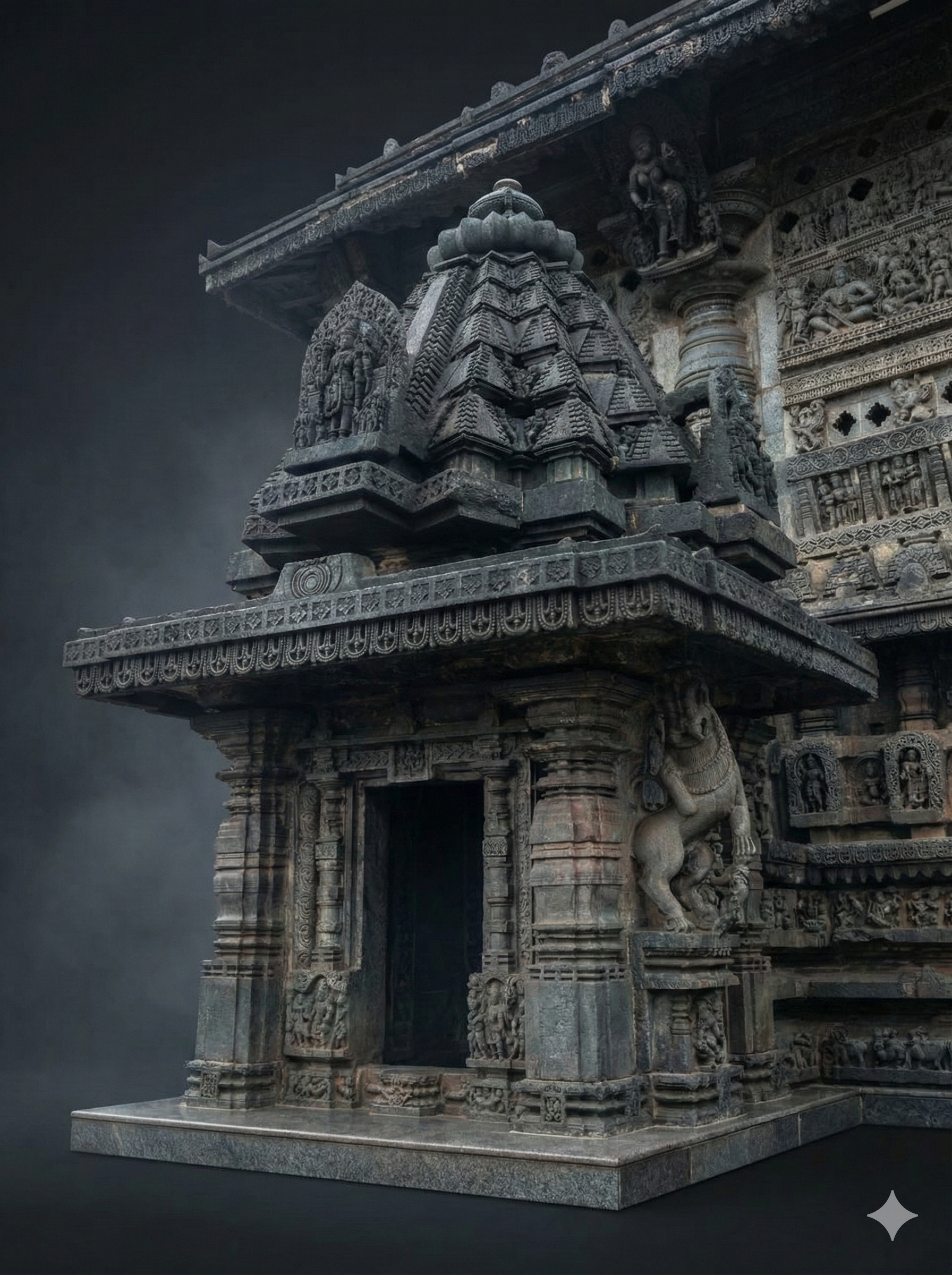
Hoysala sculptural vocabulary — the source tradition
The Gurukulam, Not a Factory
Vimāna Sanctum was formally established in 1986 — though "established" is not quite the word. There was no incorporation, no signage, no business plan. What happened was simpler and more significant: the family consecrated a workspace adjacent to the home, treated it as a gurukulam — a place where knowledge is transmitted through proximity, through watching, through decades of sitting beside.
This distinction matters. A factory optimises for output. A gurukulam optimises for transmission — for ensuring that the student's chisel moves with the same understanding as the teacher's. There is no employee handbook. There is a hundred-year muscle memory, renewed each morning when the chisels are laid out on the same wooden bench they have occupied for three generations.
The mandirs that emerge from this gurukulam are not products. They are the physical residue of a practice — artefacts of devotion that happen to take the form of sacred architecture.
"We do not have a quality control process. We have a lineage."The Achari Family, Belur
Ninety Years in a Chisel's Edge
The chisels that Natesa Achari forged in 1924 for the Thanjavur rathas are still the primary instruments of the workshop. Not as relics displayed behind glass — as working tools, drawn across rosewood and teakwood every morning. Their edges have been re-tempered countless times, their handles replaced as palms have worn them smooth. But the forged iron bodies — the part that meets the wood — are the same metal that touched the chariots of Thanjavur a century ago.
This is not sentimentality. These chisels were forged for a specific density of cut, a specific relationship between the hammer's weight and the wood's resistance. Modern tool steel, for all its hardness, does not replicate this. The old iron flexes where steel would shatter. It takes an edge differently. The artisans who use them speak of the tools as having a memory of their own — of knowing, after ninety years, where the grain wants to open.
Today, each Vimāna Sanctum commission begins with the selection of wood. Only air-seasoned heartwood is considered — timber that has been dried naturally over years, not force-dried in industrial kilns. Kiln-drying is faster, but it introduces stress into the grain. Air-seasoned wood breathes. It is dimensionally stable in a way that only patience can produce. When you tap a properly seasoned slab of Indian rosewood, it does not thud — it sings, with a clear, resonant note that the artisans use as their primary quality test.
From this wood, using those chisels, guided by that lineage, a mandir is carved over four to eight weeks. Not constructed — carved. Every Gopuram tier, every lotus column, every swan motif, every tendril of vine is released from the wood by hand. There are no CNC machines in the gurukulam. There are no laser cutters. There is the chisel, the mallet, and the understanding that passes, wordlessly, between a master artisan and the material before him.
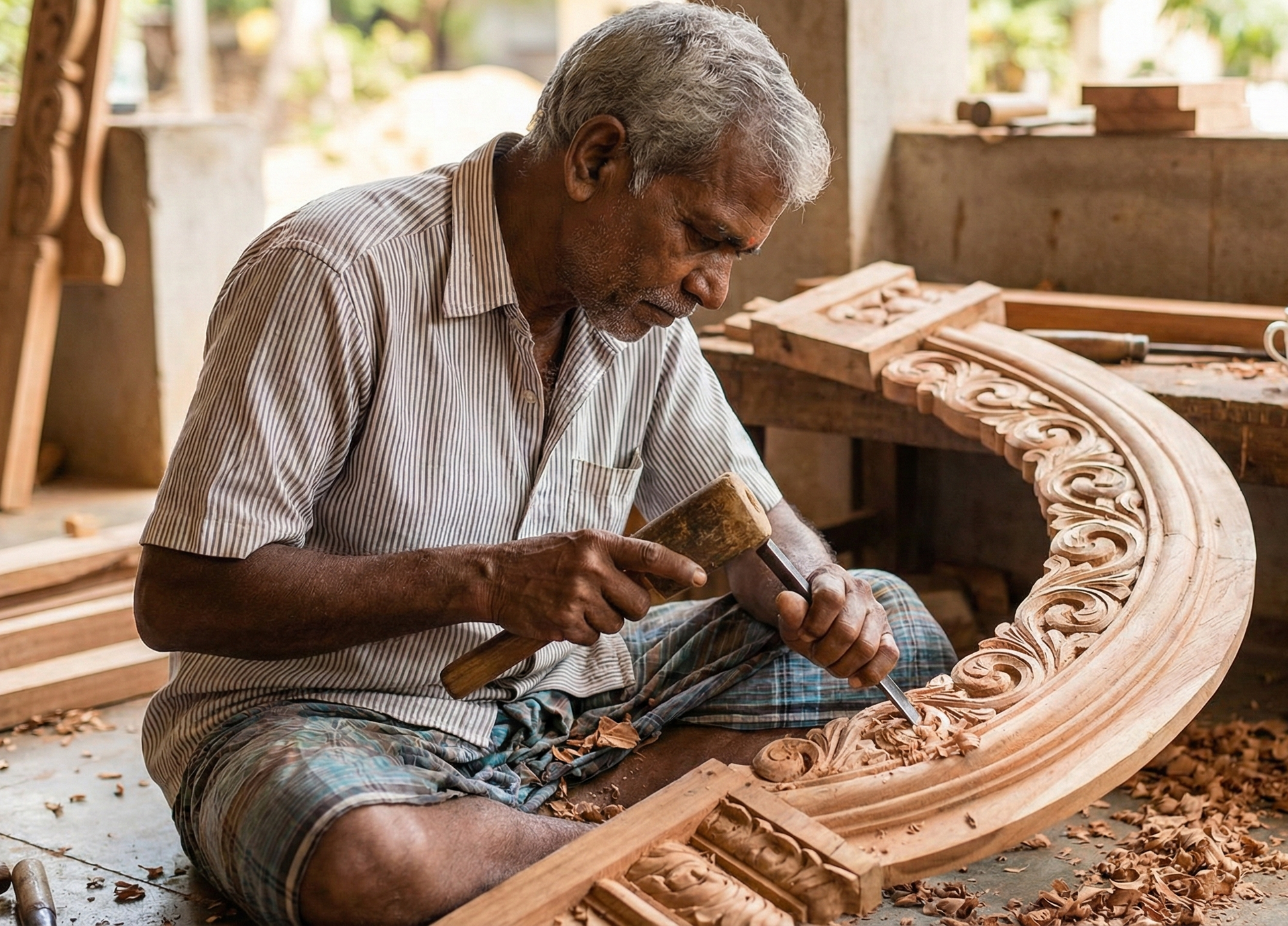
The chisel's breath — carving in progress at the Belur gurukulam
An Artefact, Not an Acquisition
A Vimāna mandir is not purchased. It is commissioned — and the distinction carries weight. To commission is to participate in the making. The patron selects the wood. They discuss the carving density, the deity motifs for the pillars, the proportions appropriate for their particular space. The artisan's office becomes, briefly, a collaborator in shaping the most sacred object their home will contain.
What arrives, after weeks of carving, is not furniture. It does not belong in a catalogue, and it does not depreciate. It is a threshold — a border between the domestic and the divine, carved from living wood by hands that carry a century of temple-building knowledge.
It will darken with age, as heartwood does. It will acquire the particular patina of incense smoke and daily worship. It will hold, in its grain, the prayers of the household that commissioned it. And when, years or decades from now, it passes to the next generation — it will carry with it not only a family's devotion, but an unbroken lineage stretching back to a young man restoring temple chariots in Thanjavur, in 1924.
Provenance Summary
Every commission carries this provenance. Should you wish to continue the lineage in your own home, we welcome your enquiry.
← Return to Home